APTITUDE
A necessary component of the D.A.R.E.S. GenAI Literacy Framework

Aptitude… is it an innate, natural ability? Or can it be studied, learned, and improved? What if the answer is both? How does aptitude affect us in our quest for understanding Generative Artificial Intelligence? Aptitude is a word that is often interchanged with skill, which is a developed talent or ability. We seldom, if ever, refer to people as having innate skills. We will instead say “innate talent” because talent implies that we are born with that ability. Skill, by its very meaning, is acquired over time. According to Crawford and Burnham, “skill is the ability to perform some given set of responses at a given time; aptitude is the ability to acquire skill under appropriate conditions” (1946, pg. 3). Why is it important to consider aptitude in relation to Generative AI?
Those who have the aptitude to learn and work with GenAI will develop those skills more quickly than those without the aptitude.
Crawford and Burnham also define aptitude as “describing an individual’s current potentialities to acquire various knowledges and skills, regardless of the original source of those potentialities” (1946, pg. 3). Current potentialities is an interesting concept because this shifts the focus from “Can someone learn from this” to “How can someone learn this based on their current capabilities?” It is no longer a question of “IF” someone can learn, but the focus has become “How is the best way for this person to learn?”
Is it important to adapt learning to the individual? Absolutely. Granted, it is more work as well, but the results of tailored learning are quick and visible. We need to take individual current potentialities into account when creating learning programs on Generative AI. “The essential purpose of teaching is to produce changes in pupils. Any program on instruction must be based upon and be guided by information concerning pupil aptitude, interest, and achievement” (Lindvall, 1967, pg. 3). And change… with GenAI, it seems to be an unstoppable force. There is no longer a question of if we will adopt this technology. It has now become a question of when. And hopefully, the answer is NOW.
We need more than a basic understanding of GenAI if we are going to be the generations that shape the future of this technology. We need to define how to teach, learn, and use GenAI in ways that are ethical, effective, and efficient. Nothing less will suffice. It is important to develop a global understanding of GenAI. And it is important that we are developing and growing aptitudes related to GenAI. “Study after study shows that people who know more about a topic reason more profoundly about that topic than people who know little about it” (Gifford & O’Connor, 1992, pg. 41). Gifford and O’Connor make an excellent point that describes the urgency of GenAI use. Increasing our aptitude of GenAI increases our ability to reason about GenAI more effectively.
Key Features of Aptitude
There are several key features of aptitude. These include what we call natural ability, learning potential, raw potential vs learned potential, and cognitive factors. Natural ability may be shown in numerical, linguistic, artistic, or logical abilities, for example. Learning potential can demonstrate how quickly and effectively someone can learn or develop expertise in a particular area. Learning to recognize the skills and aptitudes of an individual can build a solid foundation for learning as well. Cognitive factors such as memory, reasoning ability, processing speed, and pattern recognition are tied to how the brain processes information; this can be influenced by genetics, early life experiences, and education.
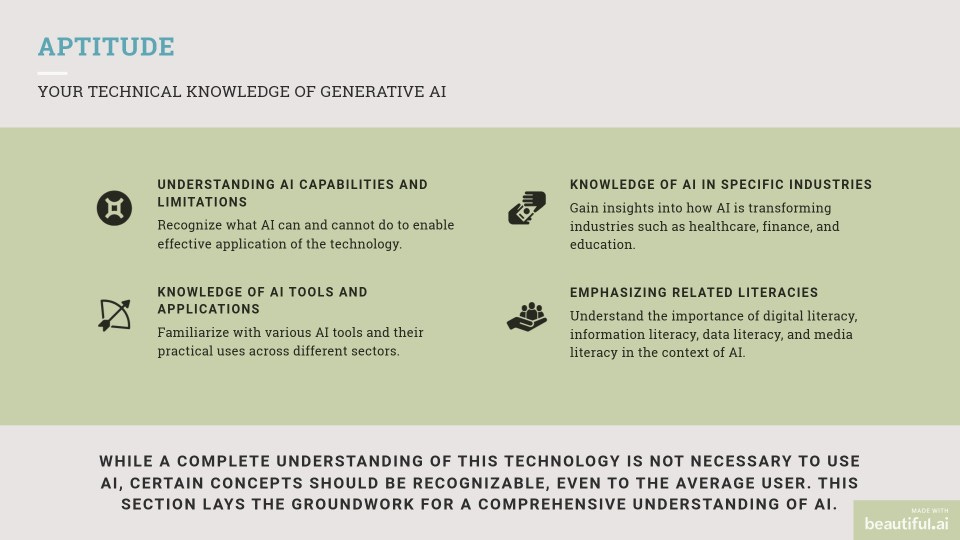
Our technical knowledge can recognize what Gen AI can and cannot do to enable effective applications of the technology. This is a time saver for learners. By familiarizing someone with the various GenAI tools and their practical uses across sectors, a deeper understanding will result, thus enhancing the learner’s aptitude. The same is true for understanding how different industries are being impacted by GenAI. This will inform decisions about whether certain industries are using GenAI in a way that ethical or potentially harmful. Another important step in developing aptitude would be to develop a basic understanding of related literacies, such as media literacy, digital literacy, and information literacy. Knowing and understanding the overlap between certain literacies can help solidify the “why” of learning GenAI.
Developing and Enhancing Aptitude
While aptitude is considered an inherent ability, it can often be enhanced through learning and practice. Even if someone has a natural aptitude for a particular skill, honing that aptitude can improve their performance and expand their potential. The more a person engages in a certain activity, the more their aptitude in that area can be enhanced. In some circumstances, trying new things can help a person discover a natural ability as well. Remember that structured learning, such as courses or coaching in a specific field, can also help sharpen aptitudes. Understanding and recognizing one's aptitudes is crucial for making informed decisions about education, career choices, and personal growth.
Teaching Aptitude
Here are a few examples provided by ChatGTP from the prompt, "Can we really use Artificial Intelligence to learn aptitude? Please give several higher-ed examples":
Yes, Artificial Intelligence (AI) can be an effective tool for learning and enhancing aptitude, particularly in higher education. While aptitude is often viewed as a natural ability, AI can help identify and nurture it by providing personalized learning experiences, instant feedback, and adaptive learning paths that target specific cognitive, verbal, numerical, spatial, and logical skills. Below are several higher-education examples where AI can be used to help students learn and improve their aptitudes:
Adaptive Learning Platforms for Cognitive Aptitude
Example: AI-Powered Adaptive Math Learning
How It Works: In higher education, AI-powered platforms can be used in courses like Calculus, Linear Algebra, or Statistics to personalize learning based on the student’s existing aptitude for mathematics.
Activity: AI platforms like Knewton or Smart Sparrow assess a student’s understanding of concepts by tracking how quickly and accurately they solve problems. If a student struggles with a specific concept (e.g., integration in calculus), the AI will adapt and present them with more targeted, foundational problems to build their skills.
AI’s Role: The AI continuously adjusts the difficulty of the problems, providing hints, explanations, or references to related material when necessary. This approach nurtures the student’s numerical aptitude, helping them build the necessary skills progressively.
Learning Outcome: Students improve their mathematical aptitude through personalized, targeted practice that is calibrated to their ability level, increasing their problem-solving skills and mathematical understanding.
AI-Assisted Language Learning to Enhance Verbal Aptitude
Example: AI Language Tutors for Writing and Comprehension
How It Works: For courses in English, Linguistics, or Communications, AI can be used to support students in improving their verbal aptitude, specifically in reading comprehension, writing, and vocabulary development.
Activity: Platforms like Grammarly or ProWritingAid analyze student writing, offering suggestions for improving grammar, style, tone, and structure. Additionally, AI-powered platforms such as Duolingo can help students practice language learning by offering personalized quizzes based on their progress.
AI’s Role: AI evaluates written work for common errors, suggests revisions, and provides immediate feedback. In the case of reading comprehension, the AI can pose questions about a text, assess the student’s understanding, and provide explanations for complex sections.
Learning Outcome: Students enhance their verbal aptitude through AI-driven feedback on their writing and reading comprehension, helping them build stronger language skills, from sentence structure to complex analysis.
AI for Developing Logical and Analytical Aptitude
Example: AI-Powered Logical Reasoning and Puzzles
How It Works: In courses like Philosophy, Computer Science, or Psychology, AI can be used to help students develop logical aptitude by providing exercises that require deductive reasoning, pattern recognition, and critical thinking.
Activity: AI tools such as Lumosity or Peak can present students with logic puzzles, brain teasers, or sequence recognition tasks, which require the application of critical thinking and reasoning skills. For example, a computer science student might use AI-powered platforms to practice algorithm design or debugging, tasks that require logical structuring and problem-solving.
AI’s Role: The AI tracks the student’s performance and offers increasingly complex problems. If a student struggles, AI can provide hints, explanations, or suggest simpler exercises to build foundational logical reasoning skills.
Learning Outcome: Students improve their ability to reason logically and solve complex problems by engaging with interactive, AI-driven puzzles and exercises that challenge their cognitive processes and enhance their logical aptitude.
AI for Improving Spatial Aptitude
Example: AI-Enhanced 3D Modeling and Visualization Tools
How It Works: In courses related to Architecture, Engineering, Design, or Geography, AI tools can help students strengthen their spatial aptitude by providing dynamic exercises for manipulating and visualizing objects in three dimensions.
Activity: AI-based tools like AutoCAD or Blender can generate design tasks that challenge students to build and modify 3D objects or environments. For example, engineering students may use AI-driven simulations to explore how structural designs behave under various stress conditions, requiring them to mentally rotate and modify 3D structures.
AI’s Role: The AI provides real-time feedback on the student’s designs, offering suggestions for improving structure, balance, or efficiency. It can also present new tasks that require more complex visualization and manipulation of 3D objects, such as designing in constrained spaces or working with real-world engineering constraints.
Learning Outcome: Students enhance their spatial aptitude by learning how to conceptualize, visualize, and manipulate objects in three-dimensional space, a skill essential in fields like engineering, architecture, and product design.
AI for Music and Artistic Aptitude
Example: AI Music Composition and Feedback Tools
How It Works: For courses in Music Theory, Composition, or Fine Arts, AI can be used to enhance musical and artistic aptitude by providing personalized feedback on composition, rhythm, harmony, and artistic technique.
Activity: AI tools like AIVA (for music composition) or DeepArt (for visual art) can generate suggestions for improving musical compositions or visual artwork based on a student’s input. For example, a music composition student could input a melody into an AI tool, which then analyzes and suggests harmonies, rhythmic variations, and structural improvements.
AI’s Role: AI helps students explore different musical styles, compositions, or artistic techniques by providing feedback and guiding the creative process. In art, the AI can help a student understand the impact of color theory, perspective, and composition on their work.
Learning Outcome: Students strengthen their musical or artistic aptitude by receiving personalized feedback and creative suggestions from AI, which enhances their ability to produce more complex, sophisticated compositions or artwork.
AI-Based Career Aptitude and Development Tools
Example: AI Career Counseling and Skill Development Platforms
How It Works: AI can help students assess their aptitude for different careers based on their academic performance, personal interests, and innate strengths. These AI-driven platforms analyze a student’s skills and suggest potential career paths or areas of further study that align with their aptitude.
Activity: AI-powered career counseling platforms like Pymetrics or Recruitee use gamified assessments to evaluate students’ cognitive abilities, personality traits, and natural inclinations. Based on the results, the AI recommends career paths or specialized courses that would best align with the student’s aptitudes.
AI’s Role: The AI provides personalized reports on the student’s strengths and weaknesses, offering insights into areas where the student may excel and suggesting ways to further develop those aptitudes.
Learning Outcome: Students gain self-awareness about their aptitudes and career potential, allowing them to make informed decisions about their academic and professional futures, while AI assists them in honing their skills for specific careers.
AI-Powered Critical Thinking and Problem-Solving
Example: AI-Generated Case Studies and Simulations
How It Works: In disciplines such as Business, Law, and Medicine, AI can be used to generate case studies or simulations that require students to apply critical thinking and decision-making aptitude.
Activity: AI systems like HoloLens or Second Life can simulate realistic scenarios where students must make decisions under pressure. For example, a medical student might use AI to diagnose a patient from a set of symptoms in a virtual clinic, while a business student could analyze market trends and make strategic decisions.
AI’s Role: The AI tracks the student’s decision-making process, offering feedback on their choices and guiding them through alternative scenarios based on their actions. It might suggest a different approach to problem-solving or provide additional context based on the student’s answers.
Learning Outcome: Students develop critical thinking and problem-solving aptitudes by engaging with AI-driven case studies and simulations, improving their ability to assess situations and make informed, effective decisions.
Using GenAI to enhance and teach aptitude is not only possible but it can also be highly effective. Generative AI can help students build and refine their aptitudes across a variety of fields, including mathematics, language, music, logic, and spatial reasoning. GenAI can promote personalized learning and allow learners to develop their innate abilities in ways that are tailored to their strengths and needs.
References
Crawford, A. B., & Burnham, P. S. (1946). Forecasting College Achievement: a survey of aptitude tests for higher education. Yale University Press.
Gifford, Gb. R., & O’Connor, M. C. (1992). Changing Assessments: Alternative views of aptitude, achievement and instruction. Kluwer Academic Publishers.